Juliane Byrenheid
(formerly Bergemann)
Classical Guitar
Romantic Guitar

The guitar used in this recording is not a modern classical guitar as commonly used today, but a 6-string guitar, as played in the time of Caspar Joseph Mertz. This is called a “Romantic Guitar” (or “Biedermeier guitar”). It differs mainly in having a smaller and more contoured body and a semi-circular bar on the soundboard with bar pins for fastening the strings to. The addition of more frets than is normal on a regular classical guitar, means that a higher tone range is possible on this instrument. The expansion of the tonal range and the creation of a universally usable guitar were the central aims for guitar makers of the 19th century. Thus, a wide variety of models were developed some with multiple necks, or mounts, to allow for the addition of open vibrating strings to provide a fuller bass sound. In this way higher and especially lower notes were added to the range of tones of the guitar.
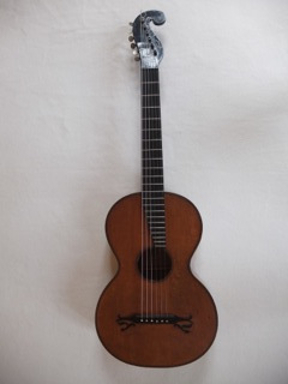
An excellent guitar and violin maker of the time was Johann Georg Stauffer who drove forward many of these structural innovations in collaboration with guitarists. These were in particular the raised fingerboard, a new tuning pegs instead of tuning pins and the use of embedded metal frets. Probably the most extraordinary development of the luthier was the Arpeggione – a fusion of cello and guitar – for which Franz Schubert composed a sonata with piano.